
Pass or Fail: Analysis of Missouri Education Data
- Scott C
- May 7, 2023
- 4 min read

Updated: Jun 6, 2023


Introduction
The most important investment is always going to be in the children. One of the ways to see the progress of children, is to look at their success in school. Test scores are one of the factors that are used to indicate how well a school is performing. In this analysis, the goal was to report the overall state of the school system by looking at graduation rates, how class size impacts graduation rates, the top schools in math and English, and overall which schools are struggling the most.
What I Learned

Graduation rates are low for over half the schools
Class size plays a role in graduation rates
The top testing schools are consistent with the schools with higher graduation rates
Being economically disadvantaged appears to have the greatest impact on success
Data:
The data set comes from Kaggle and was collected in 2017. This data was taken from the Massachusetts Department of Education website. This data set includes enrollment, student cultural backgrounds, class size, test score results, graduation, and teacher salaries.
Analysis:

This graph shows the schools where less than 50% of students graduated. When looking at some of the schools, there are a few details that stand out. The majority of the schools in this group are either charter schools[1] or alternative schools. Charter schools in Massachusetts have the freedom to create their own curriculum and teaching method [1]. Due to this, many of the charter schools are not held to the same standards with regards to covering material that will be on Massachusetts's standardized tests. Alternative schools involves an instruction approach that is offered to "at-risk" students [3]. These schools are made up of students that are not succeeding in a traditional school environment.

This chart shows average class size versus the percent graduated. Dark blue dots indicate students that are economically disadvantages. When looking at the scatter plot, you can see that the higher graduation rates are at the schools that have average class sizes between 12-24 students. This was supported by a study in the Journal of Educational Psychology. [4] An unfortunate conclusion that can be drawn is that the economically disadvantaged areas appear to have lower graduation rates. The class sizes are either really small or over the 24 that was associated with schools with high graduation rates. This seems to tie into the fact that many charter schools serve lower income families [5]. These charter schools typically have smaller class sizes. Charters can vary wildly between being among the highest achieving schools and being among the lowest achieving schools.
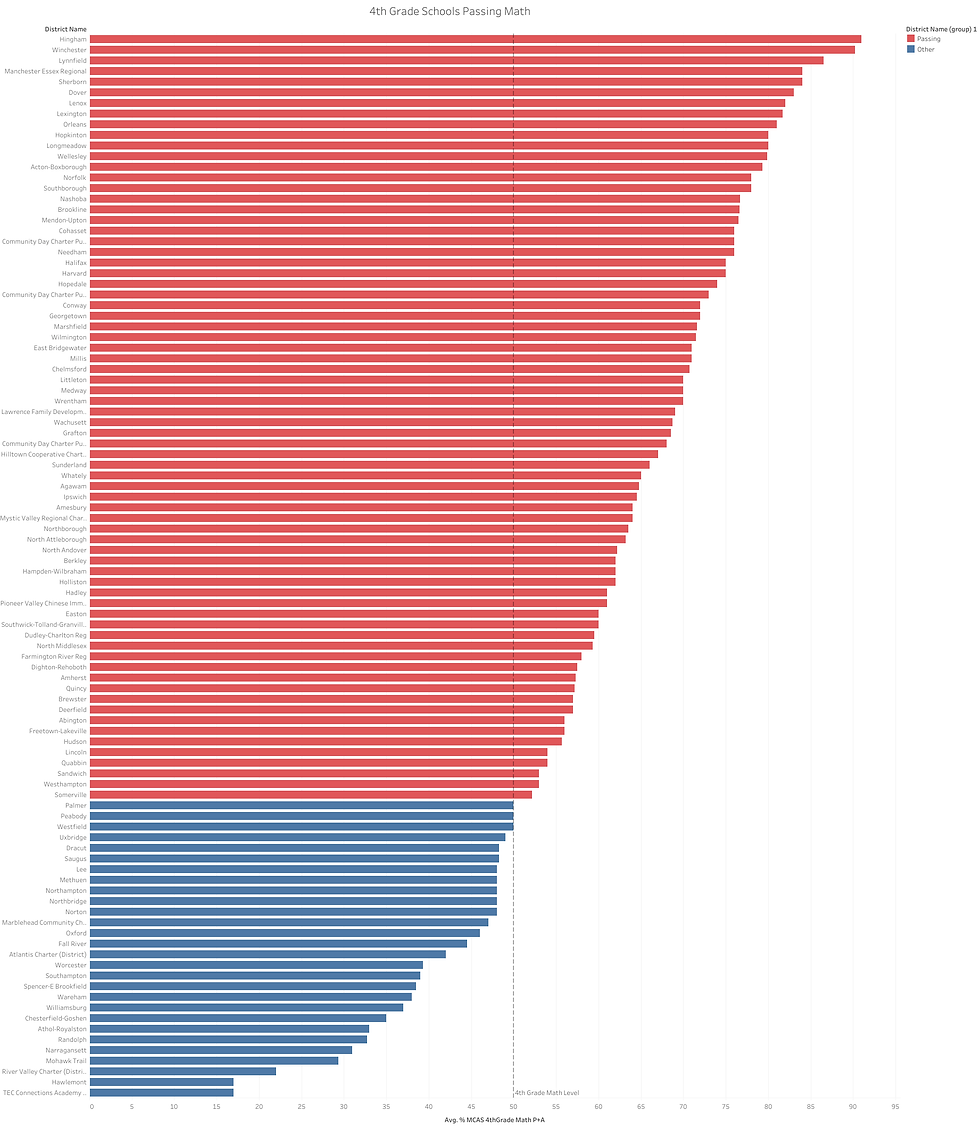 | 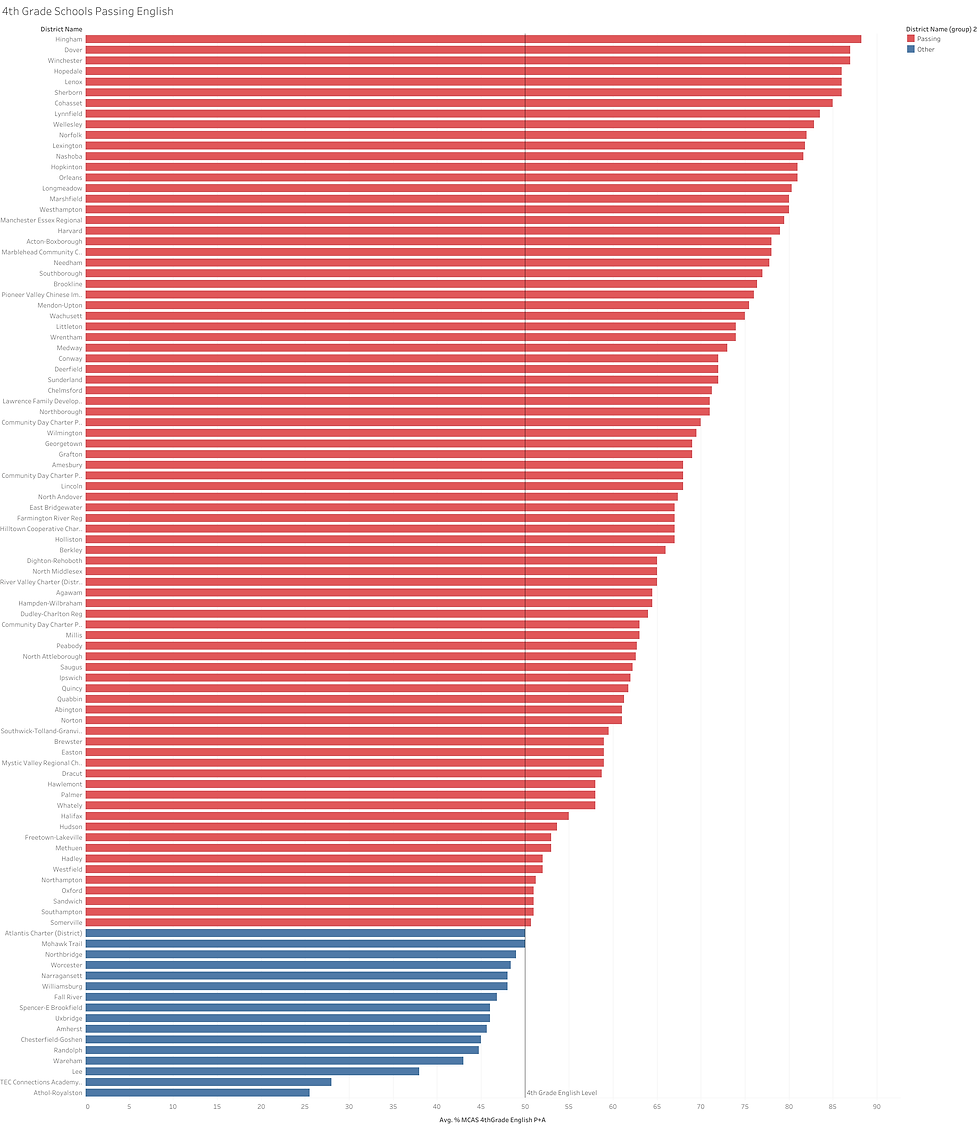 |
These images show the passing rate for all the forth graders between all school districts. Red represents those districts that have successfully passed using a metric of over 50%. When you look closely at the school districts involved, all of the school districts are pretty consistent between the highest performing on both the math and English standardized test. When looking at the majority of the higher ranking schools, they appear to belong to those districts that have a higher income. [6] Having more money is able to provide students with more opportunities and access to materials that can help with students being more successful.
The Overall Trends

When it comes to the Massachussetts School District, there appear to be several factors that play an important role in a students success. The biggest factor overall appears to be related to the funding that is provided to the school district. The school districts that have the best success with test scores and the highest graduation rates are located in those districts with a higher median income. Interesting enough, it appears that charter schools with smaller class sizes appear to benefit many of the lower income districts.
What can be done?

The results from this analysis would be useful to send to the Secretary of Education who oversees all districts. Once the results have been observed, it would important for them to speak with the superintendents of each school and recommend ways to improve the test scores and graduation rates. The school districts would need to find ways to increase funding and decrease class sizes. The analysis of this data showed that both have a high impact on overall success and graduation rates. Even though charter schools are not held to the same standards as public schools, Massachussetts does have accountability every five years [7]. If a charter school is not shown to be successful after five years, they are at risk of having their charter removed. This could serve as an incentive to help bring their graduation rates up. Overall, the most important insight to gain is to realize that funding towards schools is important in order to produce future productive citizens. Even charter schools can end up taking funding that could go towards public schools. Any way that can allow schools to be on an even playing field will pave the way to a successful generation of adults.
Sources:


Comments